When to electrify your heating
The challenges with electrification and when best to tackle them.
An ArcSett insight for industrial and manufacturing businesses.

Published: 30th September 2026 | 7-minute read
Electrification is on every roadmap – so why the hesitation?
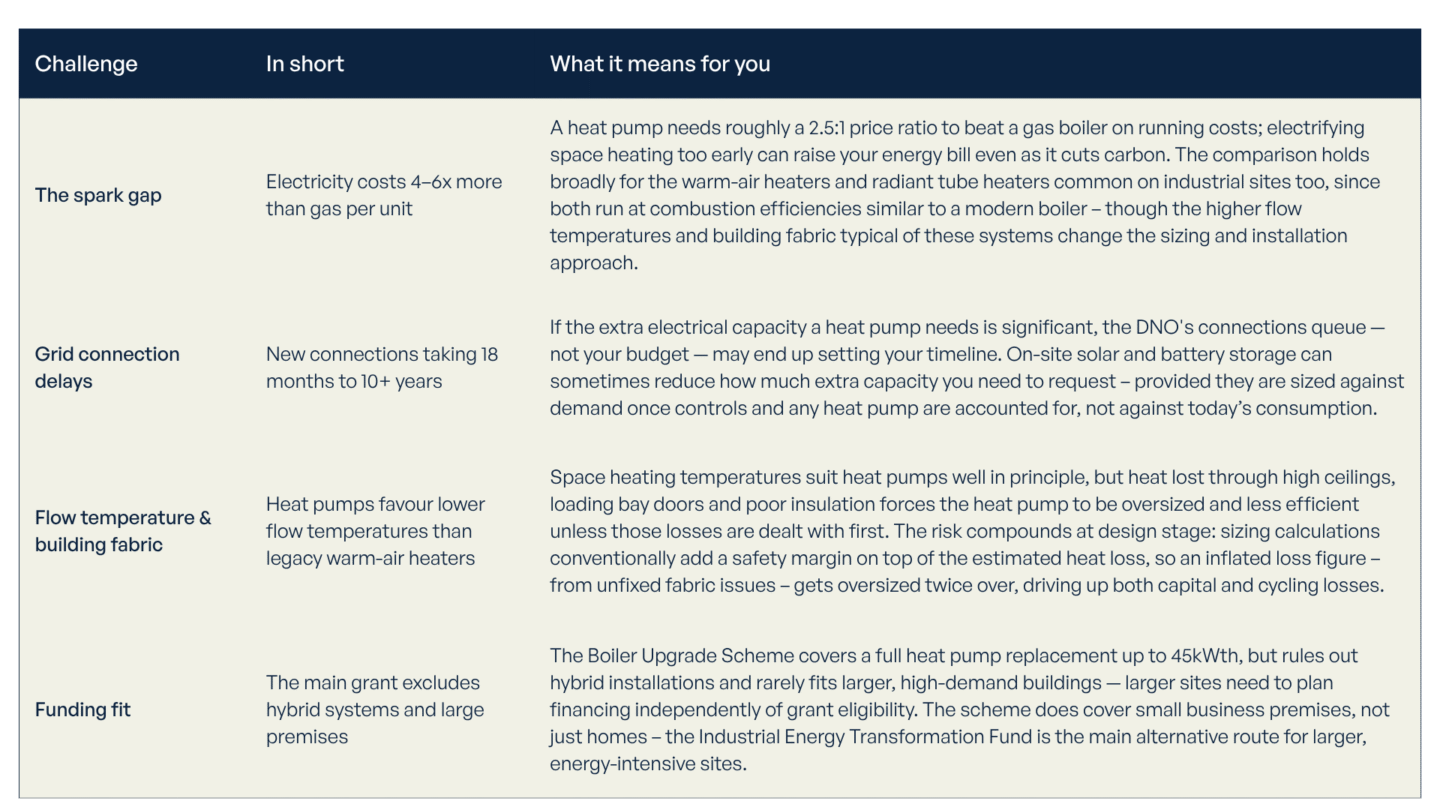
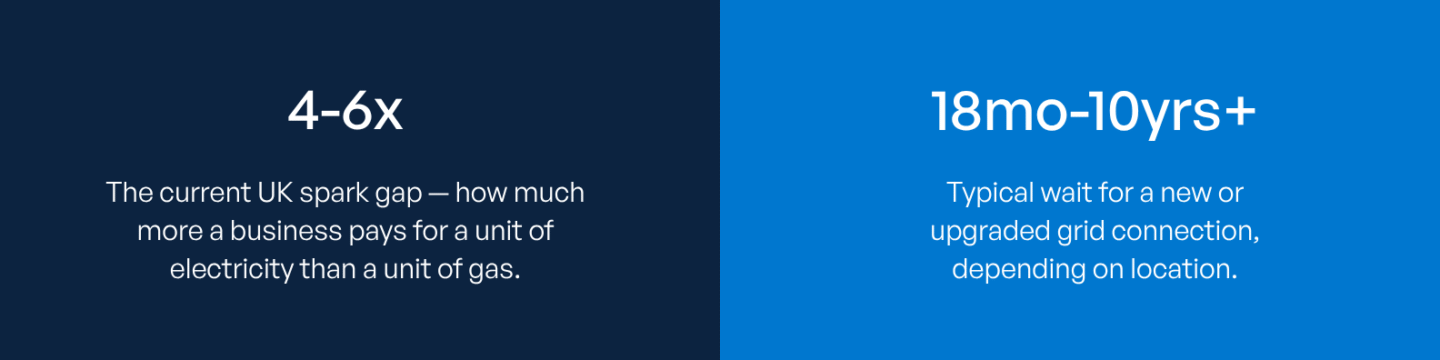
Manufacturers are under real pressure to move the gas heating that warms their factories, warehouses and workspaces onto electricity: net zero commitments, ESOS reporting and customers further up the supply chain all point the same way. Space heating is, in principle, well suited to this — it runs at far lower temperatures than industrial process heat, comfortably within the range a modern heat pump can deliver. But for most industrial sites, switching is still not a straightforward swap of one box for another. It is a capital decision, a grid decision and a timing decision all at once, and getting the sequence wrong can mean overpaying for capacity you do not need, or waiting years for a connection you should have applied for long ago. The running cost carries its own risk too: switch at the wrong moment and the electricity to run the new system can cost more than the gas it replaced, even after the carbon saving is banked. Before deciding when to electrify, it is worth being honest about the challenges that make this harder than it looks.
The four challenges to plan around
None of these rules out electrification. But each one changes the timing, and ignoring any of them tends to show up later as an unplanned cost.
The overlooked first step: control before you electrify
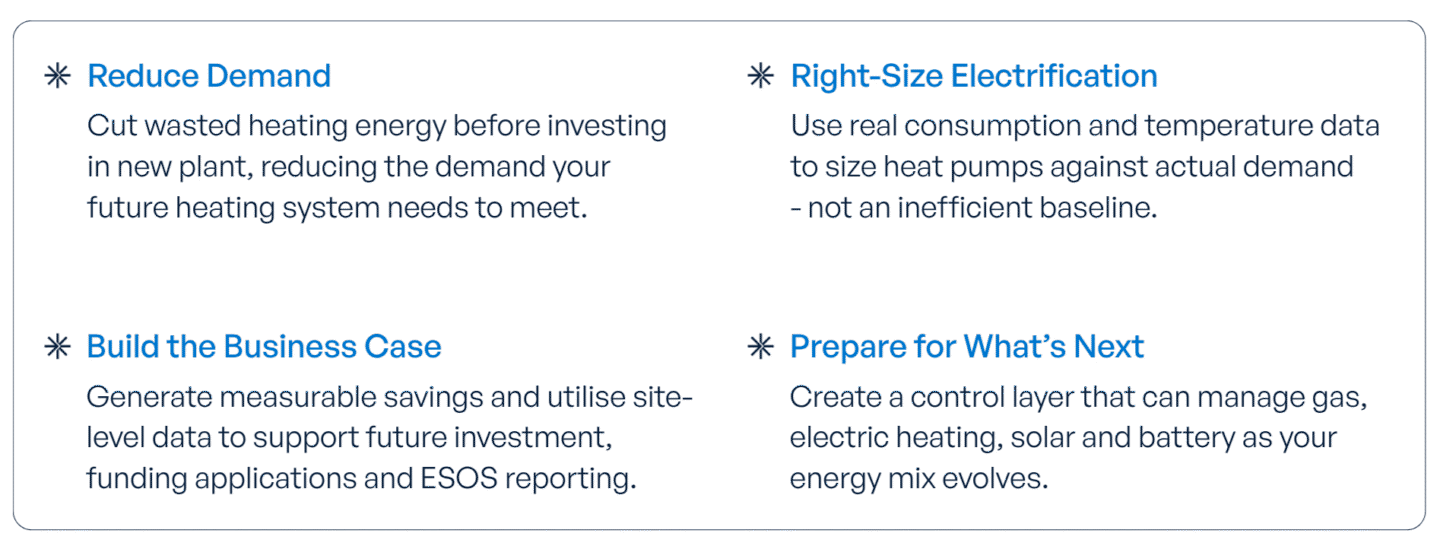
Before committing capital to a new heat pump, the single most cost-effective step a industrial business can take is to install an intelligent energy control system across the existing heating estate. Because controls read real occupancy, temperature and residual heat data and adjust output automatically — closing off heat loss through open loading bay doors, breaking up stratified hot air near the roofline, and stopping unoccupied areas being heated unnecessarily — they typically strip a substantial share of consumption off a building before a single heat pump is specified. That matters for electrification in three distinct ways.
1. It right-sizes the investment. A heat pump only needs to be big enough for the heat that is genuinely required once losses through doors, roofs and poor insulation are under control – not the inflated demand of an unmanaged building. That lowers the ongoing running cost with certainty, and – where losses like open doors, unoccupied heating and stratification were previously inflating the design calculation – can also lower the heat pump’s rated capacity and the electrical capacity you need to request from your DNO.
2. It builds the business case. Granular, site-level usage and temperature data is exactly what is needed to model a credible design and business case, support a grant or funding application, and get a grid connection request moving through the queue.
3. It carries forward into a hybrid setup. Because ArcSett’s control solution already integrates with gas, electric and oil-fired plant, the same system trimming your current gas load today becomes the dispatch layer for a hybrid site tomorrow — automatically running on whichever source is cheaper and lower-carbon at any given moment, with no need to replace the control layer as the heat source changes. This holds regardless of which fuel is doing the work on a given day – without energy controls, any heating estate, gas, electric or oil-fired, becomes harder to manage and less efficient to run.
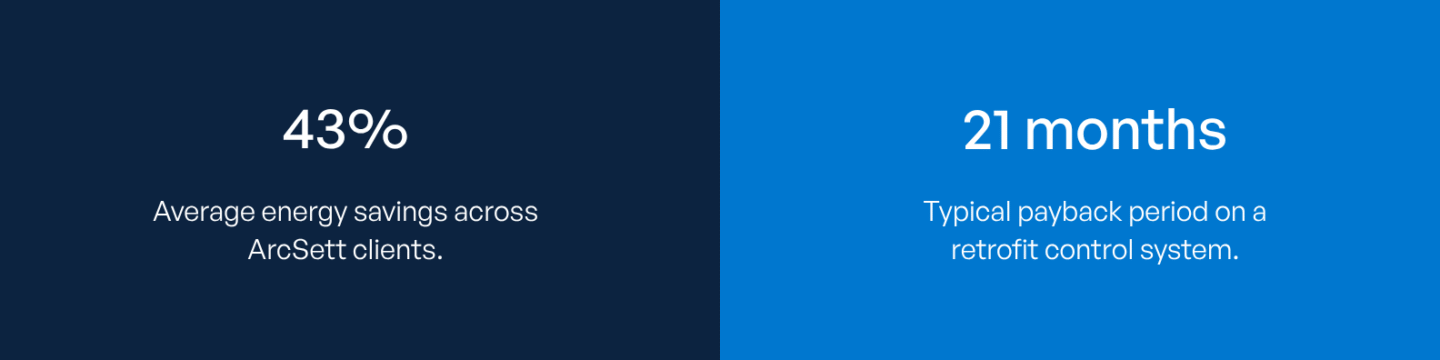
4. It builds the investment fund. A retrofit control system typically pays for itself in around 21 months and strips an average 43% off consumption – across ArcSett’s client base. Because those savings start accruing from month one, installing controls first — rather than in parallel with a heat pump — lets a business set the freed-up spend aside as part of the funding case for the heat pump project that follows, rather than having both investments compete for the same budget at once.
Where solar & battery storage fit in
Once demand has been reduced through controls, on-site solar and battery storage change the economics of the electricity a heat pump still needs to buy. UK commercial rooftop solar typically pays back in three to five years and, on a straightforward basis, can cover 70–85% of a site’s own daytime consumption — rising higher still when paired with a battery that stores midday surplus for use later. That timing matters specifically for heating: a heat pump concentrates demand into short, sharp periods — a morning warm-up and an evening heating cycle — which is exactly the load shape a battery is designed to smooth.
Drawing on stored solar or cheap off-peak electricity to cover those peaks, rather than importing at the top of the tariff, directly narrows the effective spark gap a heat pump has to overcome. It also reduces the site’s peak import from the grid, which matters because demand-related charges typically make up 30–70% of a commercial electricity bill — and, in some cases, can reduce the additional grid capacity a heat pump project needs to request in the first place. None of this has to happen before a heat pump goes in, but it is worth designing in from the planning stage: the same control layer already dispatching between gas and electric heat is well placed to bring solar and battery into that same real-time decision.

Deciding when to electrify
Deciding when to electrify should start with data, not a deadline. Once the baseline above is established, the right time to move depends less on a generic industry timeline than on how much capital is available and whether cost control or carbon reduction is the more pressing priority right now. As a general guide:
- Understand your position first. Use the data the control system has already gathered to how you are using your energy currently, how carbon-intensive that spend is, and where the remaining demand sits — this evidence, not a generic timeline, should drive every decision that follows.
- If capital allows and carbon is the priority, electrify sooner. Businesses able to fund the move now, and prioritising decarbonisation over short-term running costs can commit to a heat pump even while the spark gap is unfavourable — particularly when it is paired with the ongoing savings from energy controls and, where the site allows, on-site solar and battery storage to offset some of the running-cost premium from day one.
- If cost control is the priority, phase it. Where payback period and cash flow matter more than pace, a hybrid, control-led approach lets the building keep saving and decarbonising; in the meantime, the ongoing savings from the controls themselves help build the investment case for what comes next – adding further electric heating capacity, solar and battery as the economics and available funding align.
- Check the funding fit before committing. The Boiler Upgrade Scheme suits a full replacement on a smaller building, but its 45kWth cap and full-replacement condition rule it out for many larger sites and for any hybrid approach — plan financing accordingly rather than assuming grant eligibility. Tax relief can help regardless of route: heat pumps, controls, solar and battery storage installed by a business typically qualify for the Annual Investment Allowance, letting the full cost to be deducted from taxable profit in the year of purchase, with full expensing offering a further route for limited companies on qualifying equipment.
- Apply for the grid connection early. If the added heat pump capacity across the site is material, sizing the request against demand net of any planned solar or battery. The queue, not your budget, is increasingly the limiting factor, and applications submitted now may still take years to clear.
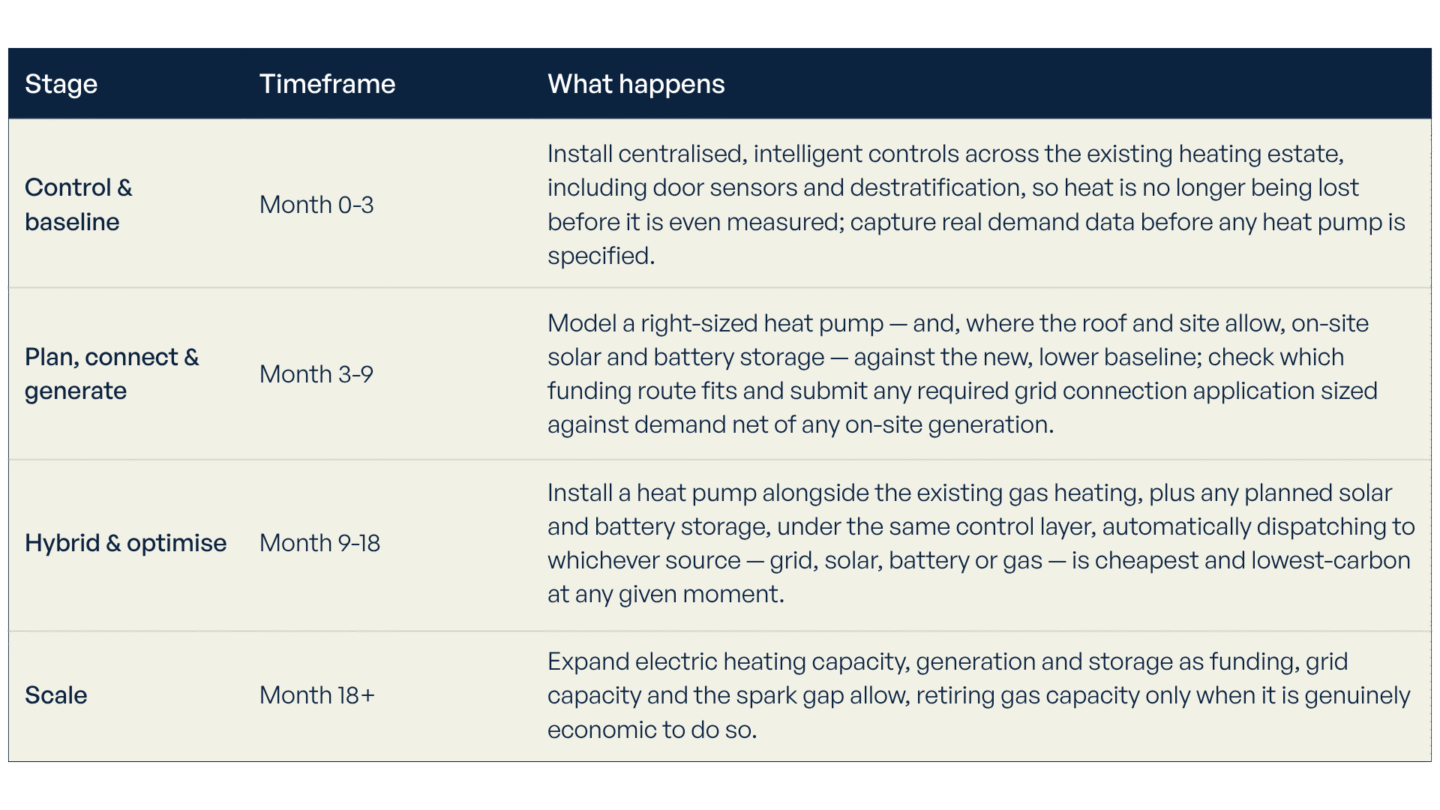
A phased roadmap to cost-efficient electrification
Sequencing determines whether electrifying your heating is an affordable transition or an expensive one. A practical four-stage approach:
Take control of the transition
Electrification is the eventual destination for most industrial space heating, but arriving well — on budget, on a realistic timeline, without unnecessary risk — depends on the sequence, not just the switch. Get the controls in first, fix the fabric losses they reveal, apply for the connection early, and let the data decide the rest.
Get in touch
Ready to power possibility, together?