Understanding Energy Market Price Volatility
How industrial operators can minimise risk and navigate the challenge.
An ArcSett insight for industrial and manufacturing businesses.


Published: 22nd October 2026 | 7-minute read
The volatility manufacturers can’t ignore
For UK industrial operators, energy has stopped behaving like a predictable overhead and started behaving like a market risk. Wholesale gas and electricity prices can swing sharply within a single quarter, and those swings flow straight through to production costs, margins and capital planning. The CBI and Energy UK have warned that around 40% of UK businesses have already scaled back investment because of energy cost pressure – a clear signal that volatility is now a strategic issue, not a background one. For energy-intensive sectors such as metals, chemicals and food processing, where gas-fired heating and process heat are core to operations, the exposure is sharper still.
What is driving the swings
The UK is structurally more exposed to gas price volatility than many of its neighbours. National storage holds around 10 days of demand, compared with roughly 90 days in Germany, so any disruption to supply shows up in UK prices faster and more severely than on continental benchmarks. Add to that a persistent geopolitical premium, from Middle East shipping risk to the ongoing reshaping of European pipeline flows, alongside a UK LNG market that competes directly with Asian buyers for the same cargoes, and a wholesale gas price behaves less like a fixed cost and more like a live global auction. Ofgem confirmed a further 4% rise in its domestic price cap from 1 October 2026, driven mainly by an 8% jump in gas costs, which is the clearest public signal yet that wholesale gas remains elevated heading into winter. The cap itself only covers domestic tariffs, but the same wholesale pressure is already feeding into commercial renewal quotes, and unlike households, businesses have no cap to soften it.
Electricity costs are under pressure for a different reason. Here, the rise comes less from the cost of generating power and more from the cost of delivering it. From April 2026, Transmission Network Use of System (TNUoS) charges, which recover the cost of building and maintaining the transmission network, are expected to rise by around 70%. Capacity Market charges, which pay for generation to be available when demand peaks, are expected to rise by around 90%. Both hit peak-time electricity use hardest, so sites with significant electrical usage face added cost on top of any movement in wholesale prices.
The real cost of unpredictability
For an industrial operator, this unpredictability is expensive in ways that go beyond the energy bill itself. Budgeting becomes guesswork, quoting for new contracts carries hidden margin risk, and capital investment gets deferred because the return depends on an energy price nobody can forecast with confidence. At the same time, industrial operators are under growing pressure to demonstrate genuine progress on efficiency and decarbonisation, whether through ESOS reporting obligations or through customers further up the supply chain asking for verifiable evidence of emissions reduction. Managing price risk and managing carbon have become the same conversation.
Comparing the strategies
There is no single fix for energy market volatility, and most industrial operators use more than one approach. It is worth weighing them side by side.
The first four strategies are, in effect, ways of trying to buy energy more cleverly. Smart energy controls take a different approach: rather than betting on where the market is heading, they simply reduce how much energy a site needs to buy in the first place. That is the one lever that works no matter which way prices move next.

Why smart controls are different
This is where a solution like ArcSett’s retrofit energy control system earns its place in a resilience strategy. It installs onto existing gas, electric and oil-based heating systems, using centralised, intelligent control that automatically adjusts to real conditions – temperature, occupancy and residual heat – rather than running to a fixed schedule. Because it works with equipment already on site, there is no operational disruption and no need to replace existing plant.
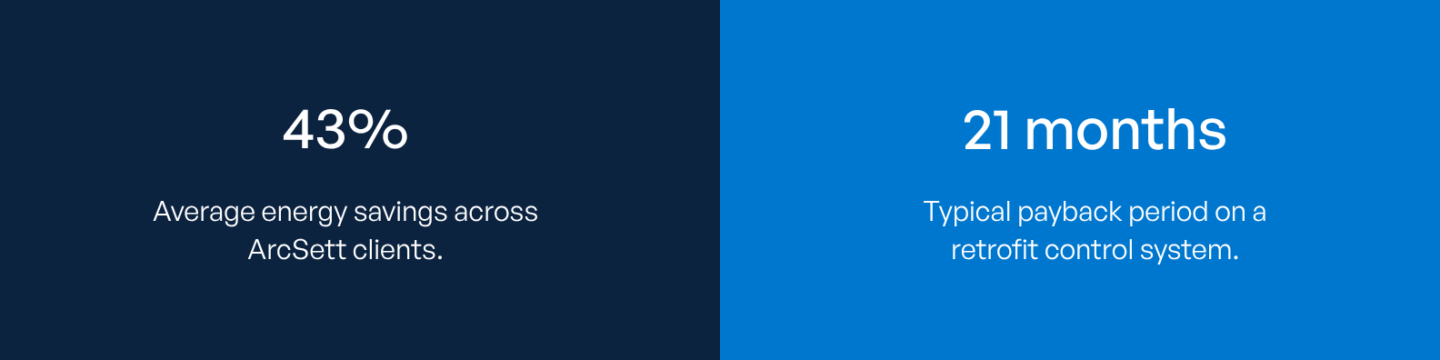
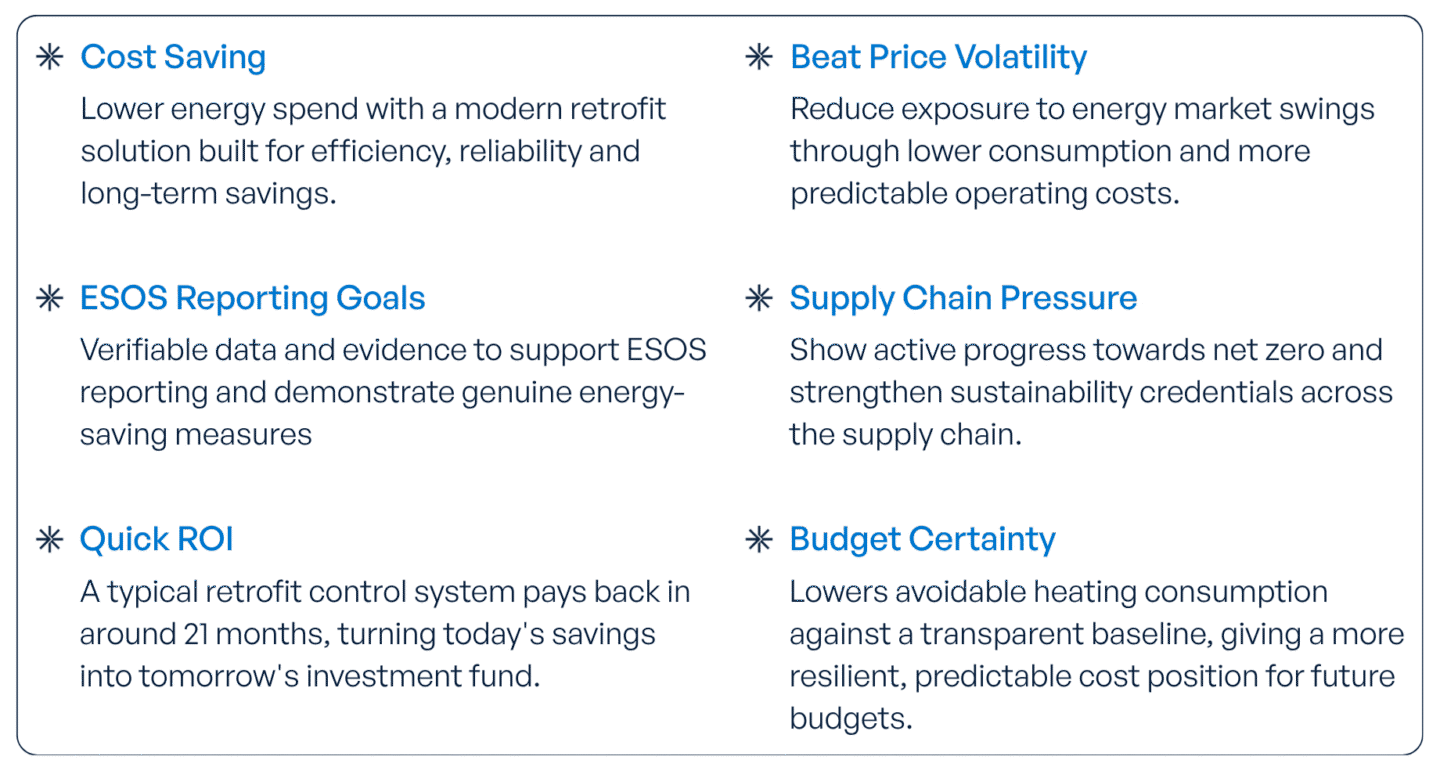
Because ArcSett’s approach lowers consumption structurally rather than tactically, it delivers on six fronts at once.
Take control of your exposure
Energy market volatility is not going away, and no single procurement strategy can fully insulate a manufacturing business from it. But the businesses managing risk most effectively are the ones combining smarter buying with smarter consumption – and using less energy, more intelligently, is the only strategy that pays off regardless of where prices go next.
Get in touch
Ready to power possibility, together?