Gas price uncertainty is back, and what you can do about it
This article explains what’s driving the current volatility, why manufacturers, logistics and high-energy businesses face the greatest exposure, and what practical steps you can take right now to protect your margins.


Published: 18 March 2026 | 5-minute read
Four years ago, businesses across the UK watched energy bills spiral beyond anything they had budgeted for. Gas prices surged, profits were wiped out, and investment was paused. And now, in 2026, geopolitical uncertainty is once again pushing energy prices into dangerous territory, with the BBC and others reporting market conditions that our clients are already feeling on the ground. Businesses that didn’t change how they manage energy costs are about to feel the impact again.
According to House of Commons research, UK energy prices have never fully recovered and remain over 35% above pre-crisis 2021/22 levels. With 89% of UK businesses reporting lower profits due to energy price volatility (PwC, 2025), further risk to profits is very real.
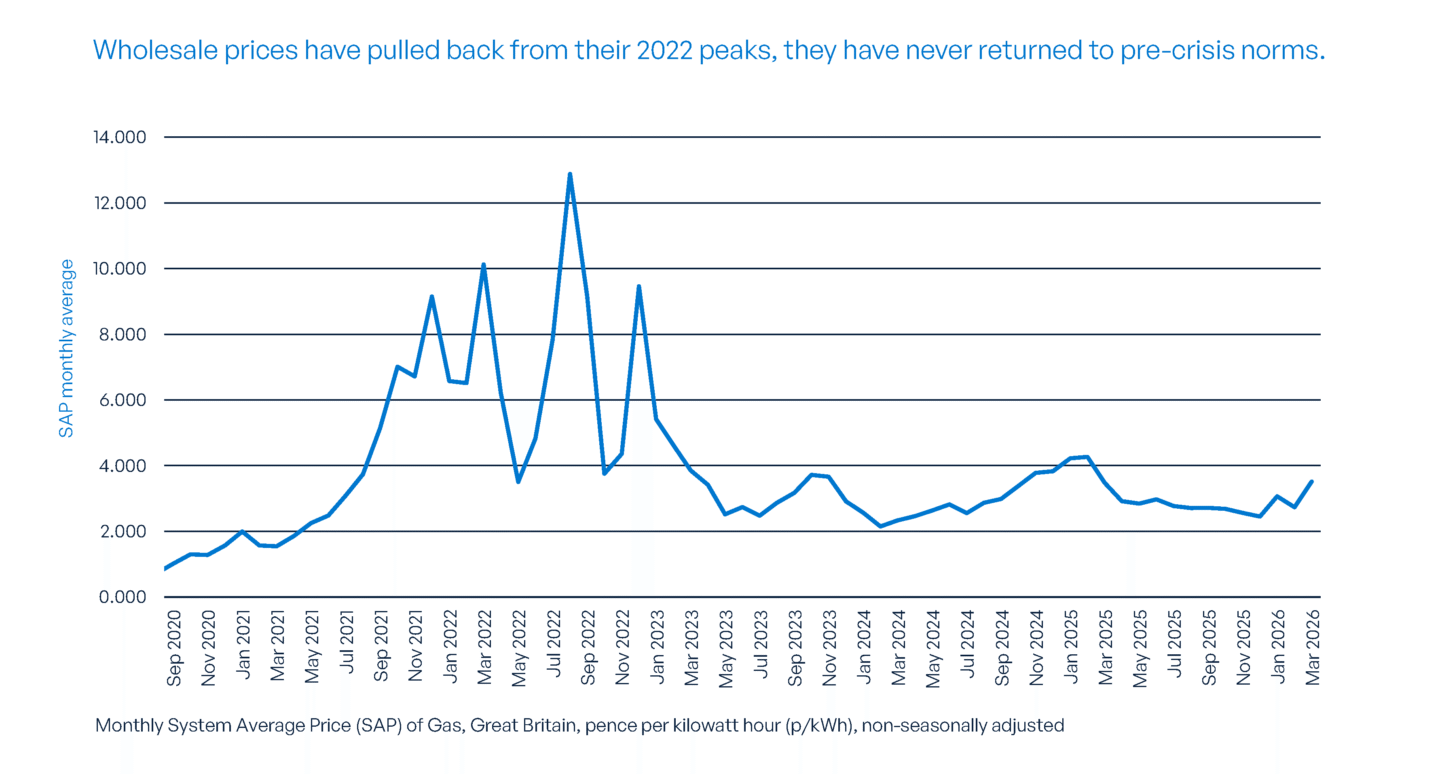
Source: ons.gov.uk, National Gas Transmission (system average price)
Why do electricity bills move when gas prices do?
The triggers will feel familiar: geopolitical tensions, now in the Middle East, affecting supply routes, tightening Liquefied Natural Gas (LNG) availability, and a European energy market still structurally dependent on gas-fired generation. The Strait of Hormuz, a chokepoint for roughly 20% of global oil and gas supply, is under serious pressure, and wholesale gas prices have responded accordingly.
As at 11 March 2026, the Office for Budget Responsibility stated that the wholesale gas price was approximately 50% higher than before the start of the conflict in Iran.
Even if your site runs on electricity rather than gas, you’re not insulated. The UK power market sets electricity prices based on the most expensive source of generation online at any given moment, and that’s almost always a gas-fired power station.
So, when gas markets spike, power prices follow automatically and immediately. Investments in efficiency or renewables at the site level are still affected; if you’re buying from the grid, you’re exposed to gas price volatility.
What can you actually do about it?
Manufacturing, logistics and high-energy-use sectors are particularly exposed. Unlike service businesses, they cannot simply reduce their hours or switch to remote working to cut consumption. Energy is baked into their production, from process heat and machinery to compressed air and lighting. When prices rise, the impact hits their unit cost base directly.
The businesses that came through 2022 in the best shape weren’t the ones that predicted the crisis. They were the ones who had already reduced the energy they needed to buy and the extent to which their costs were exposed to market swings.
DPD is a useful example. Facing rising gas costs across a national depot network, DPD needed a practical way to reduce consumption at scale without replacing their heating infrastructure. Working with ArcSett, they trialled our intelligent energy control system across their three highest-usage sites. The system was retrofitted directly onto existing radiant tube heaters, adding door sensors, precise temperature control, and a self-learning preheat algorithm that calculates the minimum warm-up time needed before each shift.
The results across 14 depots, measured after just four months, were an average 68% reduction in gas consumption, totalling 3.35 million kWh saved. This was not the result of replacing their systems. It was the result of better controlling what they already had.
Three things worth doing now:
- Reduce your gas consumption directly.
Process efficiency, heat recovery, door sensor control, and smarter scheduling can significantly reduce consumption without capital expenditure on new equipment. Most sites have considerable waste hidden in heating schedules and heat loss that simple control measures can eliminate. - Cut your overall energy demand.
Fewer energy units consumed onsite means you’ll have less exposure to whatever price those units are sold at. Using controls can reduce the amount of energy needed, whereas voltage optimisation will reduce the energy lost between the energy delivered and the equipment it runs, often achieving a 5-15% saving. - Get visibility of where your energy actually goes.
Most sites have inefficiencies that energy monitoring can quickly surface, such as compressed air waste, overheating, or equipment running outside shift patterns.
None of this requires a complete site overhaul. Often, the highest-value changes are operational and not capital-intensive, and the payback periods, as DPD and others have found, are typically under two years.
How ArcSett helps businesses get ahead of gas price risk
At ArcSett, energy price volatility is one of the risks we help businesses get ahead of.
Our energy control system retrofits to your existing heating, air-conditioning and ventilation equipment. No replacement or downtime is needed. It gives you visibility into where energy is going across your site and the intelligent control to stop wasting it through smarter scheduling, residual heat circulation, door sensor control, and self-learning preheat optimisation.
The result isn’t just a lower bill. It’s a reduction in how much of your energy use is exposed to fluctuations in gas prices.
By proactively managing this exposure, what might otherwise be a costly disruption becomes mitigation, moving energy from a reactive cost problem into a managed risk. Our clients typically see average savings of 43%.
If you’d like to understand whether your business is more exposed than it needs to be, what practical steps are available to you and what’s worth addressing first, book a discovery conversation. Fifteen minutes, no obligation and no sales pressure.
Get in touch
Ready to power possibility, together?